
Table of Contents
If you have ever stood on a yoga mat in a dimly lit, air-conditioned studio in Nungambakkam and then tried the same sequence at sunrise on Besant Nagar beach, you know the experiences are worlds apart. One offers a controlled, predictable sanctuary; the other presents a sensory-rich, slightly unpredictable dialogue with nature. So, is outdoor yoga better than indoor yoga?
The answer isn’t a simple “yes” or “no,” but rather a “where do you need to find balance today?” As we navigate 2026, the shift toward “Green Exercise” has made outdoor yoga a powerhouse for mental health and sensory integration. Practicing outdoors challenges your proprioception with uneven terrain and boosts your mood through “biophilia”—our innate connection to the natural world.
However, indoor yoga remains the king of precision and focus. For those in Chennai, where the humidity can reach 80% by mid-morning, the climate-controlled indoor space is often a necessity for high-intensity practices like Ashtanga or Power Yoga. Ultimately, “better” depends on whether you are seeking the grounding stability of a flat floor or the expansive, spirit-lifting energy of the open sky.
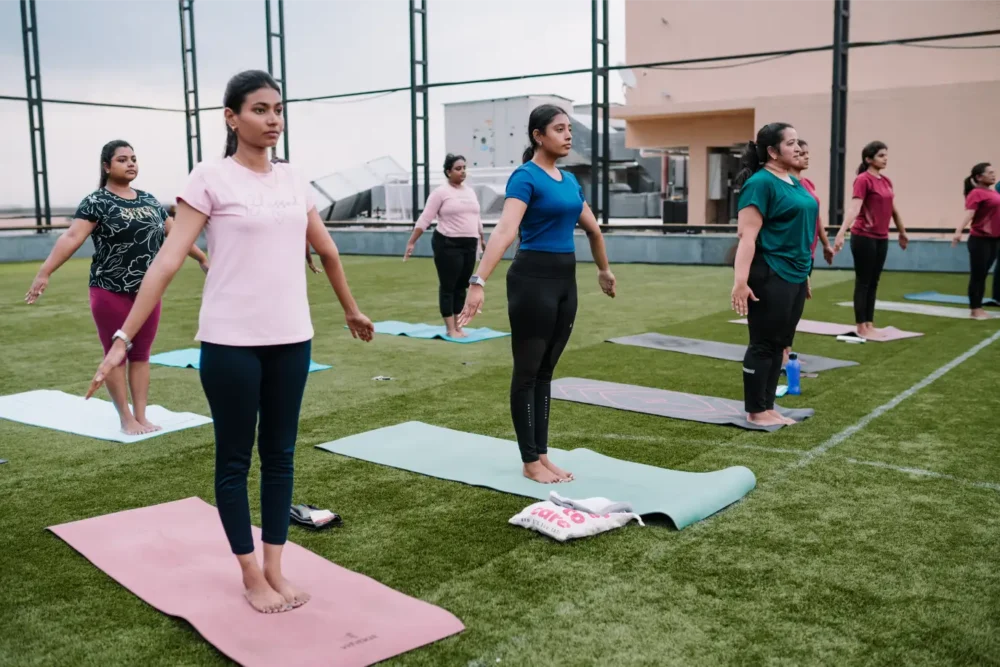
Outdoor yoga is the practice of asanas, pranayama, and meditation in natural environments like beaches, parks, or rooftops, utilizing the elements to enhance sensory awareness. Indoor yoga occurs in a dedicated studio or home space, providing a controlled environment (lighting, temperature, flat surface) to facilitate deep internal focus and technical alignment.
In a city as vibrant and relentless as Chennai, our nervous systems are under constant siege. The hum of traffic on Anna Salai, the blue light of our laptops in OMR, and the confined spaces of urban living create a “sensory starvation” that yoga seeks to heal.
Choosing between indoor and outdoor practice matters because each environment triggers a different physiological response. Outdoor yoga activates the parasympathetic nervous system through the sounds of birds or crashing waves, a phenomenon known as “Soft Fascination.” Indoor yoga, conversely, allows for “Pratyahara” (withdrawal of the senses), helping you drown out the external world to hear your own breath. Understanding this distinction allows you to use your yoga practice as a surgical tool for your specific mental state.
The environment changes how your body moves and how your brain processes the movement. Here is a breakdown of the mechanics:
Indoor floors are engineered to be flat. This allows you to focus 100% on muscle engagement. Outdoors, the slight incline of a park lawn or the shifting grains of sand at Thiruvanmiyur beach forces your “stabilizer muscles” (the tiny muscles in your ankles and core) to work twice as hard to keep you upright.
Indoor air, even with high-quality purifiers, is recycled. Outdoor air—especially near the coast—is rich in negative ions. These ions are believed to increase our capacity to absorb oxygen and improve serotonin levels, making every Pranayama session more impactful.
In a studio, your “Drishti” (focal point) is often a spot on a wall or a mirror. Outdoors, your gaze can travel to the horizon. This “panoramic vision” tells the brain it is safe, instantly lowering cortisol levels compared to the “narrow focus” we use while looking at phones.
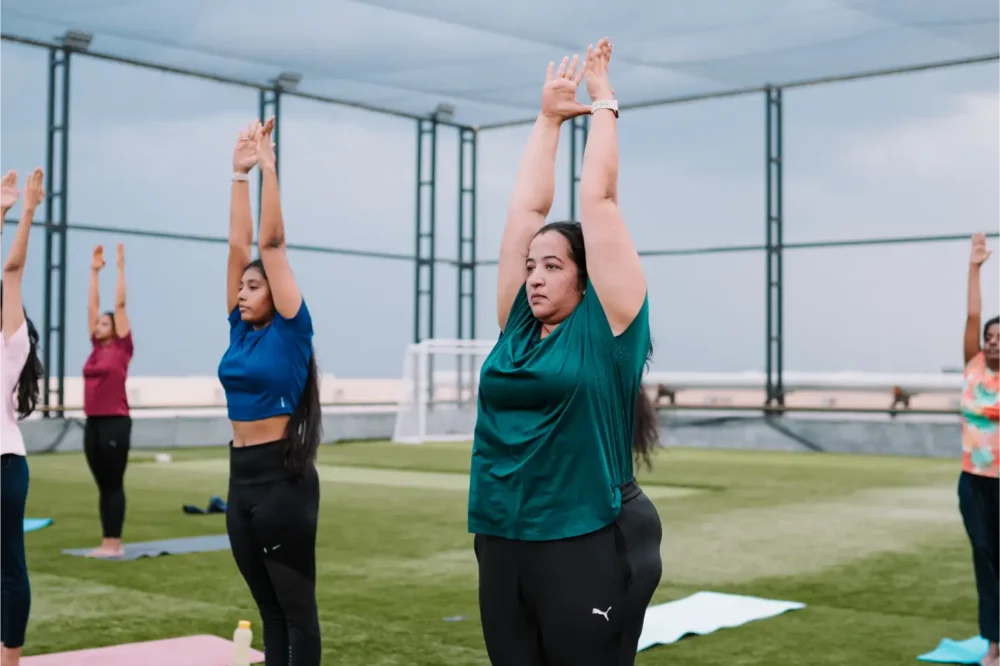
Because nature isn’t flat, outdoor yoga builds “functional” balance. Your body learns to adapt to micro-movements, which translates to better stability in everyday life—like walking on uneven pavements or navigating a crowded Chennai Metro.
“Attention Restoration Theory” suggests that looking at nature allows the brain to recover from the fatigue caused by “directed attention” (work/screens). An outdoor session at dawn doesn’t just stretch your hamstrings; it cleanses your mental “cache.”
There is a reason the ancient yogis practiced in forests and caves. Feeling the sun on your skin (Surya) and the wind against your face (Vayu) creates a sense of “Awe.” Research shows that experiencing awe makes us more patient, less stressed, and more connected to our community.
If you are just starting your journey, the choice can feel daunting. Here is a practical roadmap:
- Start Indoors for Alignment: If you don’t know the difference between Warrior I and Warrior II, start in a studio. The mirrors and flat floor will help you build a safe foundation.
- Transition Outdoors for Joy: Once you know the basics, join an Outdoor Yoga Chennai group. The community vibe of a park or beach batch is often less intimidating and more social than a silent studio.
- Mix and Match: Use the “3:1 Rule.” Practice three days indoors to work on your technique and one day outdoors to “let go” and enjoy the sensory experience.
- Check the Logistics: Before heading out, look up Yoga classes in Chennai fees. Many outdoor sessions are “pay-as-you-wish” or lower cost than premium boutique studios.
“Outdoor yoga is just for ‘Instagrammers’.” While the views are beautiful, outdoor yoga is a rigorous tradition. The lack of mirrors forces you to feel the pose rather than see it, which is the true essence of yoga.
“You can’t get a ‘real’ workout outdoors.” Try doing a plank on sand or holding a balance pose while a gust of wind hits you. The lack of climate control means your body works harder to maintain its core temperature, often burning more calories.
“Indoor yoga is boring.” Not at all. A dedicated studio allows for “props” (blocks, straps, bolsters) that can deepen a pose in ways that are difficult in a park. It is a laboratory for the body.
- The Footwear Factor: For indoor yoga, high-quality “sticky” mats are great. For outdoor yoga, consider a “yoga towel” or a natural jute mat that handles moisture and sand better.
- Timing the Chennai Weather: In Chennai, the “outdoor window” is small. Practice between 5:30 AM and 7:15 AM. After that, the heat makes the practice more about survival than spirituality.
- Sun Protection: Even at 6:30 AM, the tropical sun is strong. Use a sweat-resistant sunscreen so it doesn’t run into your eyes during “Downward Dog.”
- Embrace the Distractions: Outdoors, a dog might bark or a crow might fly past. Instead of getting annoyed, use these as “Zen tests.” Can you stay in your breath despite the noise?
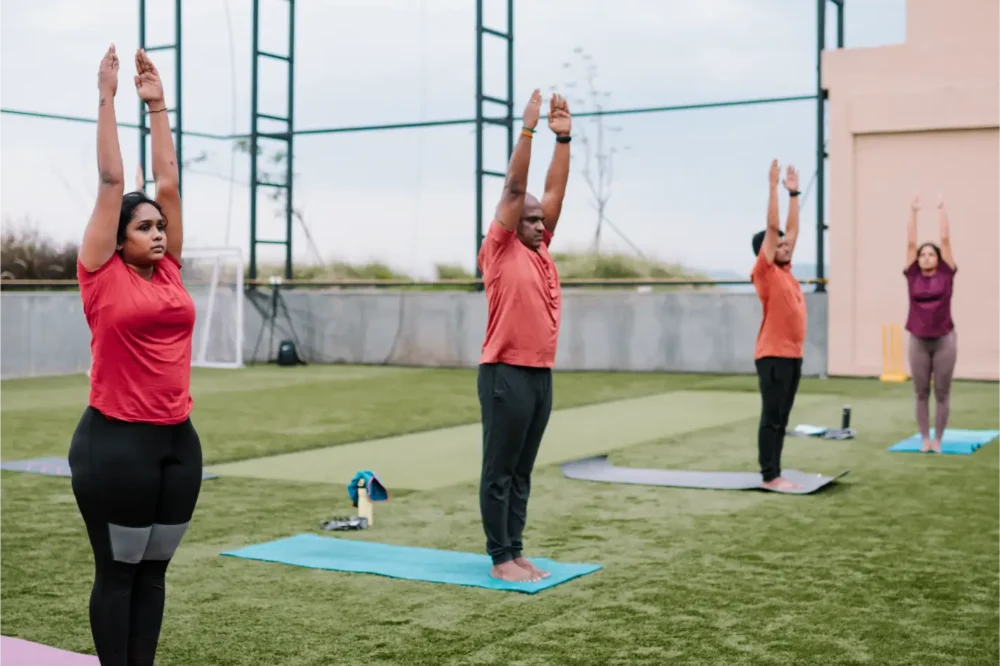
Vikram spent 10 hours a day in a windowless office. He practiced at a high-end gym indoors but still felt “tight.” He switched his Saturday practice to an outdoor session at the Theosophical Society gardens. The combination of bird song and natural light helped him break his “chronic stress loop” in a way the gym never could.
Priya was recovering from an ankle injury. She tried practicing in a park but found the uneven grass painful. She moved her practice to a local studio with a high-density foam floor. The predictable surface allowed her to rebuild her joint strength safely before she eventually returned to outdoor sessions.
1. Is outdoor yoga safe during the Chennai monsoon? It is better to stay indoors. Apart from the rain, the humidity spikes can make breathing feel heavy, and wet surfaces increase the risk of slipping.
2. Which beach is best for yoga in Chennai? Besant Nagar (Bessie) is excellent for its community feel and cleaner sands. Thiruvanmiyur beach is better if you prefer quietude and fewer onlookers.
3. Do I need to worry about insects in Chennai parks? Yes. If practicing in places like Semmozhi Poonga, use a natural citronella-based repellent. Early mornings are generally fine, but “dawn and dusk” are peak mosquito times.
4. Are indoor yoga fees higher than outdoor ones? Typically, yes. Indoor studios have overheads like rent, AC, and cleaning. Outdoor sessions are often more affordable or donation-based.
5. Can I do “Hot Yoga” outdoors in Chennai? Technically, any yoga in Chennai at 9:00 AM is “Hot Yoga.” However, true Hot Yoga (Bikram style) requires controlled humidity. Practicing in the natural Chennai heat requires extreme caution regarding hydration.
6. Is the sea air bad for my yoga mat? Salt and sand can degrade rubber mats over time. If you practice outdoors, rinse your mat with fresh water and mild soap once a week.
7. Can beginners do outdoor yoga? Yes, but they should choose a class specifically labeled “Beginner-friendly” to ensure the teacher gives verbal cues that compensate for the lack of mirrors.
8. What should I wear for outdoor yoga in Chennai? Lightweight, breathable cotton is best. Avoid dark colors that absorb the morning sun, and ensure your clothes allow for a full range of motion.
In the end, neither environment is objectively “better.” Indoor yoga is a sanctuary for the mind’s precision, while outdoor yoga is a sanctuary for the soul’s expansion.
If you feel cluttered and distracted, go indoors and find your focus. If you feel boxed in and weary, go outdoors and find your breath. In a city as multifaceted as Chennai, we are lucky to have both options. The most important thing is that you unroll your mat—wherever that mat may be—and take that first deep breath.
Would you like to experience the best of both worlds? [View our schedule for Indoor Precision Batches and Weekend Beach Sessions today!]
