
Table of Contents
Chennai is a city of dualities. One side of us craves the high-tech, air-conditioned comfort of the OMR corridors, while the other side longs for the salt-scented breeze of the Bay of Bengal. This internal tug-of-war often shows up in our wellness choices: Should I join a polished indoor studio or head to the sands of Besant Nagar for beach yoga?
Choosing between beach yoga and studio yoga in Chennai isn’t just about the scenery; it’s about aligning your practice with your lifestyle, physical needs, and the city’s unique tropical rhythm. A studio offers a sanctuary from the humidity and noise, providing a controlled environment for deep focus. On the other hand, the beach offers “Natural Oxygen Therapy,” where the rhythmic sound of waves acts as a built-in meditative track.
In this guide, we’ll break down the nuances of both options. Whether you’re a beginner looking for your first mat or a seasoned yogi wanting to switch up your routine, understanding the “Chennai factor”—from our 5:30 AM sunrises to the monsoon rains—will help you make the right choice for your body and mind.
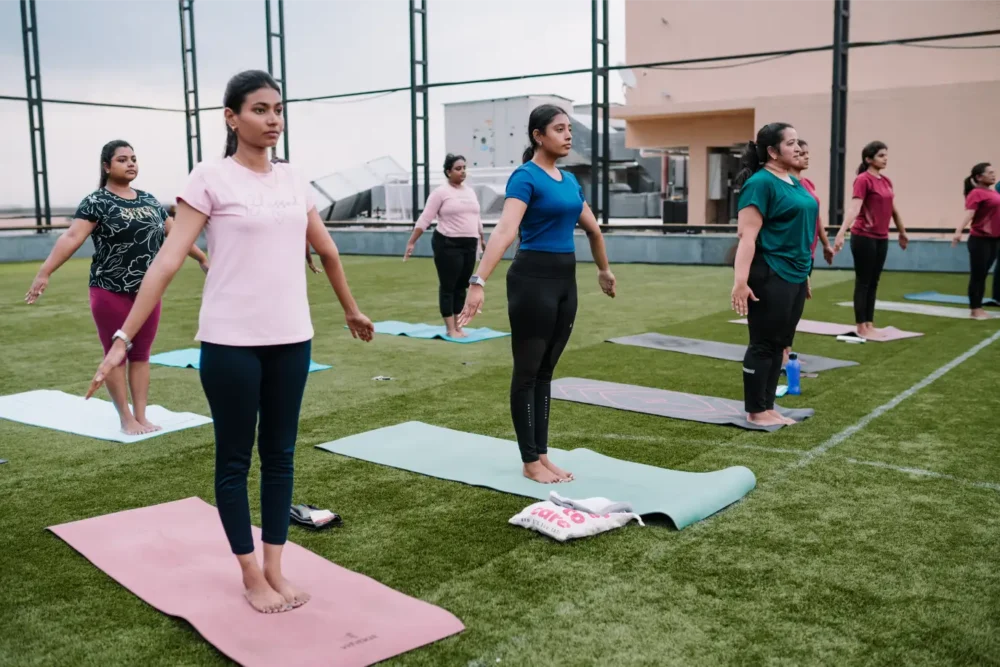
| Feature | Beach Yoga (Outdoor) | Studio Yoga (Indoor) |
| Surface | Shifting Sand (Grounding/Challenge) | Stable Hardwood/Tile (Alignment) |
| Environment | Natural Air & Vitamin D | Climate-Controlled (AC) |
| Best Time | 5:30 AM – 7:30 AM | Flexible (All Day) |
| Noise Level | Ambient (Waves/Birds/Bustle) | Quiet & Focused |
| Cost (Monthly) | ₹1,500 – ₹3,500 | ₹3,500 – ₹7,000 |
| Distractions | High (Public, Weather) | Low (Private, Consistent) |
Choosing “the right” yoga isn’t a one-size-fits-all decision. In Chennai, the heat and traffic often dictate our choices more than the style of yoga itself. Consider these three criteria before booking your next batch:
Do you feel “boxed in” after eight hours in an office cabin? If so, the vastness of Thiruvanmiyur Beach might be the mental reset you need. Conversely, if you find the outdoor sounds of Chennai—crowing roosters or early morning walkers—too distracting, the soundproof walls of an Alwarpet studio will serve you better.
If you are recovering from an ankle or knee injury, the stable floor of a studio is essential for safety. However, if you want to strengthen your stabilizer muscles and core, the uneven surface of the sand provides a natural, functional challenge that no gym floor can replicate.
In Chennai, “proximity is peace.” If you live in Anna Nagar, a beach yoga session in South Chennai might become a stressful trek. Always choose a location that adds less than 15 minutes to your commute to ensure long-term consistency.
Practicing near the ocean triggers what scientists call the “Blue Mind”—a mildly meditative state characterized by calm and unity. In Chennai, this usually happens at the crack of dawn.
- Top Spots: Besant Nagar (Bessy), Thiruvanmiyur, and the quieter stretches of ECR.
- The Experience: You start in the dark, and by the time you reach Savasana, the sun is painting the sky in shades of saffron and pink.
Chennai is home to world-renowned institutes that prioritize classical lineage and therapeutic precision.
- Top Spots: Krishnamacharya Yoga Mandiram (KYM), Sivananda Centre, and boutique spaces like 136.1 Yoga Academy.
- The Experience: These spaces provide high-end props (bolsters, blocks, straps) that allow you to explore poses with clinical accuracy, often under the guidance of teachers with decades of pedigree.
- Pros: Free Vitamin D, higher oxygen levels, naturally improves balance, and usually more affordable.
- Cons: Humidity can make you slip, no mirrors for self-correction, and weather-dependent (monsoon pauses).
- Pros: AC comfort during April-June heat, fewer mosquitoes, professional props, and exclusive women-only batches are more common.
- Cons: Recirculated air, higher membership fees, and limited space in popular batches.
- Beginners: Studio Yoga is often better. The stable floor and mirrors help you learn the basic “geometry” of poses without the added challenge of sand.
- IT Professionals (OMR/ECR): Beach Yoga is a top choice. It counteracts “Zoom Fatigue” and provides a much-needed digital detox in a wide-open space.
- Stress Relief Seekers: Beach Yoga. The negative ions produced by breaking waves are scientifically proven to increase serotonin levels.
- Therapeutic Needs (Back pain/PCOS): Studio Yoga. Specialized institutes in Chennai offer personalized “Viniyoga” sequences tailored to specific ailments.

The “Yoga Institute in Chennai fees” vary widely based on location and luxury.
- Outdoor Yoga Chennai (OYC): Typically ranges from ₹1,500 to ₹3,500 per month. The value lies in the community and the natural healing environment.
- Boutique Studios (Nungambakkam/Adyar): Often range from ₹4,000 to ₹8,000 per month. The value here is in the amenities—showers, premium props, and temperature control.
If budget is a primary concern, outdoor sessions offer the highest “health-per-rupee” ratio, as nature provides the “decor” for free.
- Ignoring the Seasonal Shift: Don’t sign up for a 3-month beach membership in October without asking about the monsoon plan. Most outdoor groups move to Zoom or sheltered spaces during heavy rains.
- Overestimating Your Heat Tolerance: Practicing at 8:00 AM on a Chennai beach in May is not yoga; it’s an endurance test. Always stick to the 5:30 AM or 6:00 AM batches.
- Assuming Beach Yoga is “Easy”: Sand makes every pose 30% harder. Don’t be surprised if your “simple” tree pose results in a tumble!
Arjun, an architect, struggled with focus. He found studios too “clinical.” He joined a sunrise batch at Thiruvanmiyur Beach. The sound of the ocean became his focal point (Drishti), helping him stay in poses longer. The grounding effect of the sand helped his anxiety in a way a wooden floor never did.
Srimathi, 55, had mild arthritis. She tried a park session but found the damp grass and uneven ground painful for her knees. She switched to a traditional studio in Alwarpet. With the help of chairs and wooden blocks provided by the studio, she could practice safely and comfortably.
1. Is beach yoga safe for seniors in Chennai?
It can be, but a studio is generally safer due to the flat, predictable surface. Sand can be tricky for those with balance issues or joint pain.
2. What should I bring to a beach yoga class?
A thick natural rubber mat (to prevent slipping on sand), a large towel to wipe off the salt, and a water bottle. Sunscreen is essential even at 6:00 AM.
3. Do studios in Chennai offer trial classes?
Yes, most boutique studios offer a paid or free “drop-in” trial. Outdoor groups like Outdoor Yoga Chennai often host “Open House” sessions for newcomers.
4. How do I handle the humidity during beach yoga?
Practice early! The humidity peaks as the sun rises. Using a cotton yoga “Dhurrie” on top of your mat helps absorb sweat and provides better grip.
5. Are there ladies-only batches for beach yoga?
While beach sessions are usually mixed and public, many studios in Anna Nagar and Nungambakkam offer exclusive ladies-only morning hours.
6. Which is better for weight loss?
Both are effective, but beach yoga often burns more calories because your muscles work harder to stabilize your body on the uneven sand.
7. What happens if it rains in Chennai?
Studio yoga continues as usual. Most outdoor yoga groups have a “Hybrid” model where they switch to live online sessions during rainy days.

In the Beach vs. Studio debate, there is no “wrong” answer—only the answer that fits your current season of life. If you need discipline and alignment, start with a studio. If you need freedom and a soul-deep recharge, head to the coast.
Ready to explore?
- Step 1: Visit a beach session this Sunday to see how the sand feels under your feet.
- Step 2: Schedule a trial at a local studio to compare the energy.
- Step 3: Commit to a 21-day habit, regardless of the venue.
Would you like me to recommend the best sunrise yoga timings for your specific neighborhood in Chennai?
